
Boost Efficiency & Cut Costs: Why Industrial Pipe Descaling Tech is Essential
Industrial pipe descaling in Bracknell uses tech like hydro-jetting to reduce downtime, boost ROI by 545%, and prevent “fatbergs.” Proactive care saves £4 for every £1 spent on reactive repairs.
- 12 min read
Key Insights Summary
Industrial pipe descaling tech is a critical necessity for maintaining the operational integrity of Bracknell’s commercial corridors. Systematic mineral calcification and congealed fats reduce pipe capacity, resulting in $1.4 trillion in annual unplanned downtime worldwide. Preventive maintenance programs yield an average ROI of 545% by delaying asset replacement and preventing structural failure. In Bracknell, legacy infrastructure near landmarks like Gardens requires specialized hydro-jetting and robotic descaling to combat “fatbergs” and mineral scale.
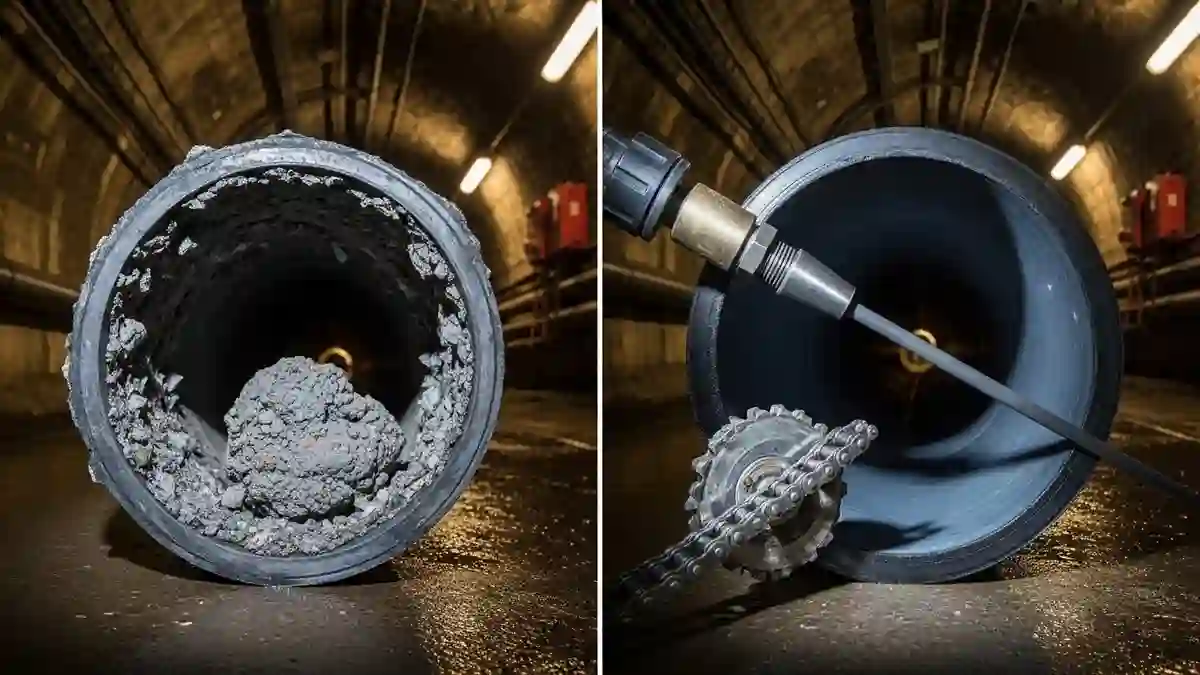
Bracknell’s industrial landscape is a complex blend of Victorian-era masonry and modern high-tech facilities. From the pharmaceutical hubs in Park to the logistics giants near Bracknell, the subterranean infrastructure is the lifeblood of our local economy. However, beneath the surface, a silent crisis is mounting. The accumulation of mineral scale and saponified fats is constricting our pipelines, leading to increased energy costs, reduced flow, and the looming threat of catastrophic failure.
As senior consultants, our team has observed that many facility managers in the area view drainage as a “fit and forget” system. This is a costly misconception. Modern industrial pipe descaling tech is no longer a luxury; it is a vital strategic asset for any CFO or Managing Director concerned with the bottom line.
How Much Will Drainage Failure Cost Your Business If You Delay Descaling?
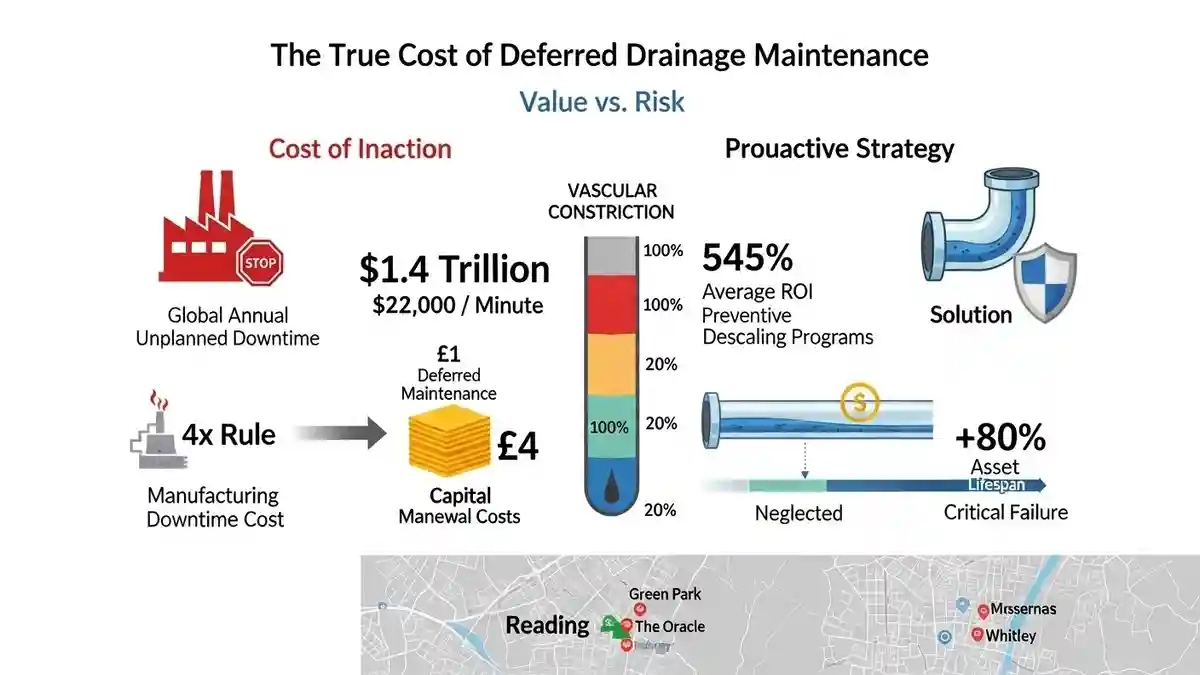
The most common question we encounter from executives along the main Road is: “What is the true cost of waiting?” The data provides a sobering answer. Unplanned downtime costs the world’s top companies roughly $1.4 trillion every year. In the industrial sector, specifically manufacturing, an unscheduled stop can cost up to $22,000 per minute.
For a Bracknell-based warehouse or retail unit, a total sewer blockage means more than just a plumbing bill. It means lost productivity, potential stock loss due to flooding, and a tarnished reputation. Every £1 of deferred maintenance in a drainage system often quadruples to £4 in future capital renewal costs as the pipe degrades from a “cleanable” asset to one that requires total replacement.
By investing in preventive industrial pipe descaling maintenance and regular service, businesses can achieve a 545% return on investment. This ROI is achieved by extending the pipe network’s lifespan by up to 80% and drastically reducing the frequency of emergency repairs.
What are the 3 Signs a National Franchise is Overcharging Me?
National franchises often dominate the Bracknell drainage market. Still, their high-pressure marketing and corporate overhead can lead to significant overcharging. Our team’s audits of regional industrial sites have identified three consistent red flags:
- The “Phantom” Team Size: Many franchises will bill for a two-person “specialist team” when a single technician with a portable FlexShaft machine could have completed the job. A recent National Trading Standards investigation highlighted a case where a customer was charged over £5,000 for work that an independent expert valued at just £54.
- Estimated Surface Area Billing: For industrial parks, drainage charges are often calculated using aerial imagery or historical data. If your site has permeable grassed areas or has been redeveloped, you may be paying for surface water drainage services that your rainwater never uses.
- Lack of Pre- and Post-Video Verification: If a contractor cannot provide side-by-side CCTV evidence using industry-standard reporting software such as WinCan Enterprise, they are likely overcharging for a partial clean. Professional industrial descaling should always include an “as-left” video showing the pipe walls restored to their original capacity.
Technical Analysis: The Physics of Drainage Failure
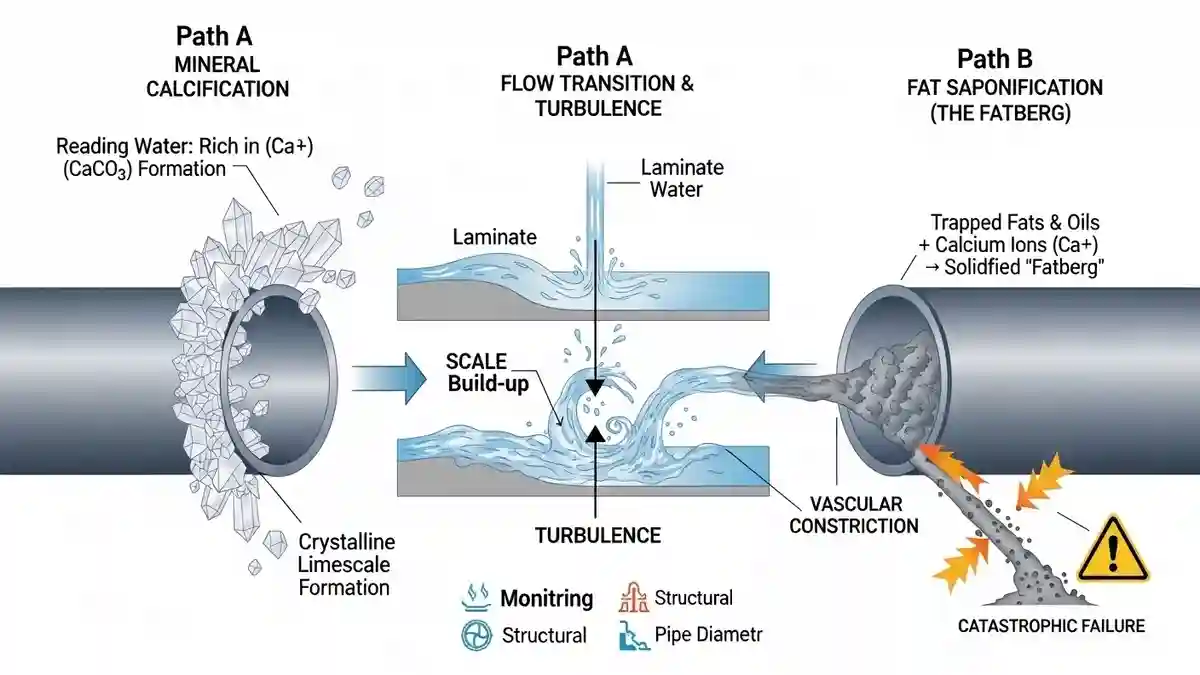
To manage risk effectively, one must understand the physical mechanisms that lead to pipe failure. In the Bracknell region, our team focuses on two primary drivers: mineral precipitation and fat saponification.
Bracknell’s proximity means our local water is naturally rich in minerals, such as calcium. When industrial effluent—which is often warmer or under different pressure—enters these lines, the calcium begins to precipitate from the water. This is not a soft buildup; it is a crystalline formation known as limescale or calcium carbonate.
This mineral scale acts as a “nucleus,” providing a rough surface for other waste to latch onto. This is where the physics of flow transitions comes into play. As the scale builds, it creates turbulence. Instead of flowing smoothly through the center of the pipe, the waste begins to swirl and crash against the walls. This turbulence traps organic oils and fats, triggering a process called saponification.
Saponification is the chemical reaction in which fats combine with calcium ions (present in Bracknell’s water and concrete pipes) to form a solid, soap-like mass as hard as concrete. This mass, commonly known as a “fatberg,” is essentially a chemical deposit that bonds to the pipe structure and hardens over time. Once this bond is formed, it cannot be cleared with simple “snaking” or consumer-grade chemicals; it requires the intense force of industrial descaling.
How Can We Determine if Our Current Maintenance Schedule is Inadequate?
- Is the drainage slow-draining despite regular “unblocking”? If a line consistently slows down shortly after a standard service, it is a sign that the pipe diameter has been permanently reduced by scale. You aren’t dealing with a blockage; you are dealing with “vascular constriction”.
- Are we paying for “surface water” we don’t use? If your site near the local area has been upgraded with sustainable drainage (SuDS) or soakaways, your bill may still be based on outdated municipal estimates.
- What is the consequence of failure (COF)? If a main line under your server room or loading bay collapses, the cost is not the repair—it is the loss of business continuity.
Choosing the Right Tech: Methods and Equipment
High-Pressure Hydro Jetting
High-pressure water jetting is the gold standard for industrial water pipe scale removal solutions. By applying pressures up to 3,000 bar (approx. 43,500 psi), we can disintegrate mineral scale and fatbergs without using toxic acids.
The speed of the water jet (exceeding 600 meters per second) creates shock waves that crack the brittle mineral deposits, flushing them out as solid waste rather than hazardous liquid runoff. This makes hydro-jetting the most eco-friendly industrial pipe descaling technique available for Bracknell businesses.
Mechanical Descaling with Ridgid FlexShaft
For smaller lateral lines (1.25″ to 6″) often found in offices and retail units at Street Mall or Park, we use Ridgid FlexShaft machines. These machines feature chain knockers that spin at high speeds inside a nylon sheath, expanding to the full diameter of the pipe. This provides a “wall-to-wall” clean, particularly effective for removing waxy grease and light scale that jetting might miss.
The Heavy Fleet: Whale Tankers
For mainline sewers beneath industrial estates, like a local industrial estate, we deploy Whale Tankers, specifically the 32-tonne sewage vacuum model. These vehicles are equipped with:
- Pratissoli MW Series Pumps: Delivering up to 269 liters per minute at 155 bar for massive flushing power.
- Whale Smart Control: An interface that allows the operator to fine-tune pressure, protecting older Victorian masonry from the stress of excessive force.
- Deodorizers: Essential for working in high-traffic areas, to mask the “weapons-grade” odors associated with disturbed fatbergs.
Is Your Cured-In-Place Pipe (CIPP) Liner Engineered to Withstand External Pressure?
When descaling reveals structural damage, such as cracks in older clay pipes, the solution is often trenchless pipe relining or Cured-In-Place Pipe (CIPP). This involves inserting a resin-saturated felt or fiberglass liner into the existing pipe and “curing” it with heat or UV light to form a new, jointless pipe within the old one.
However, not all liners are created equal. In Bracknell’s flood-prone zones near the Thames, external groundwater pressure can be significant. If a liner is not engineered with sufficient tensile strength (typically up to 3,000 psi for pressure lines), it can suffer from “lifts” or “sags”.
A “lift” occurs when groundwater infiltrates the host pipe and pushes against the liner before it has fully cured, or when the installation pressure is too low to counteract the external hydraulic load. Our team uses WinCan AI to detect these defects early, ensuring that the structural integrity of your rehabilitated line meets the 50-year lifespan required by institutional investors and property managers.
Case Study: Restoring Flow to a Bracknell Landmark
A recent project near the town center is a prime example of the effectiveness of modern descaling technology. A hospitality group reported chronic backups that traditional “rodding” had failed to fix. Our team conducted a CCTV drain survey and discovered a significant mineral deposit near a junction with the main sewer line on a nearby street.
Using a combination of a Whale 32T Jet-Vac and Ridgid carbide-tipped chain knockers, we removed a “stalactite” of mineral scale that had reduced a 150mm pipe to just 40mm of effective flow. By restoring the “as-built” diameter, we eliminated the turbulence that was trapping grease, effectively preventing a future fatberg. The client’s maintenance spend on that line dropped from monthly emergency call-outs to a single bi-annual check, a clear example of how preventative industrial pipe descaling secures long-term ROI.
Conclusion: A Proactive Approach to Asset Management
The message for Bracknell’s business leaders is clear: your drainage infrastructure is either a ticking financial time bomb or a well-managed asset. The cost of industrial pipe descaling services is a fraction of the expense associated with total system failure, lost productivity, and the £22,000-per-minute cost of downtime.
By utilizing advanced industrial pipe descaling equipment from brands such as Whale, Ridgid, and WinCan and insisting on data-driven reporting, you can protect your property’s foundations and your company’s profitability. Do not wait for the “foul smell” or the “slow drain” to signal a crisis. Be decisive, be professional, and invest in the tech that keeps Bracknell’s economy flowing.
FAQs
Can descaling tech improve boiler efficiency?
Does descaling prevent local rat infestations?
Is descaling safe for older clay pipes?
Can descaling software map hidden drainage assets?
Does descaling help meet discharge regulations?
Talk to your local Bracknell Drainage specialist
We are always happy to arrange a free site assessment and no obligation quotations for any work you might need. Alternatively, you can call our emergency hotline number on