
24/7 Emergency Sewer Response: Your First Call for Any Disaster
Bracknell’s 24/7 emergency sewer response prevents £14k+ in structural damage. Experts use Whale Tankers to resolve Victorian pipe failures caused by saponification.
- 16 min read
Key Insights Summary
An emergency sewer failure in Bracknell demands immediate intervention due to the region’s high density of Victorian clay pipes and the unique pressure exerted by London Clay soil. Delays in addressing a midnight backup can escalate costs from a £150 clearance fee to over £14,000 in structural repairs. Professional remediation relies on high-spec equipment, such as Whale Tankers and Wincan VX diagnostics. National franchises often overcharge through commission-based incentives and vague pricing. Immediate isolation of water and professional triage are the only ways to prevent permanent property devaluation.

The Infrastructure of Bracknell
A Legacy of Victorian Engineering under Modern Stress
The subterranean landscape represents a challenging intersection of mid-19th-century engineering and 21st-century urban density. Much of the region’s core drainage network, particularly around established arterial routes, relies on infrastructure designed for a population a fraction of its current size. In the 1840s, when much of the primary sewer layout was conceptualized, the system was designed to serve roughly 50,000 people; today, it serves a metropolitan area.
The primary conduits in central Bracknell consist largely of antique brick and ceramic pipes. While these materials have demonstrated remarkable longevity—a testament to the engineering standards of the era—they are increasingly reaching their structural limits. The local geological context adds another layer of complexity. Bracknell sits upon extensive deposits of London Clay, a soil type known for its high moisture retention and low permeability. This creates a high-pressure environment in which groundwater cannot readily drain away, resulting in significant pressure on the external walls of older masonry sewers.
When the system is subjected to modern environmental stresses, such as the record rainfall recently observed, the Victorian network frequently fails. These failures often manifest as sudden collapses, as seen in recurring issues in which sewer repairs have historically caused significant disruption to local bus routes and commercial activity.
Technical Analysis: The Science of Drainage Failure
As senior drainage consultants, our team looks beyond the immediate symptoms of a blockage to understand the molecular and mechanical forces at work. The two most critical factors in emergency sewer failure are the chemical process of saponification and the physical impact of hydrostatic pressure.
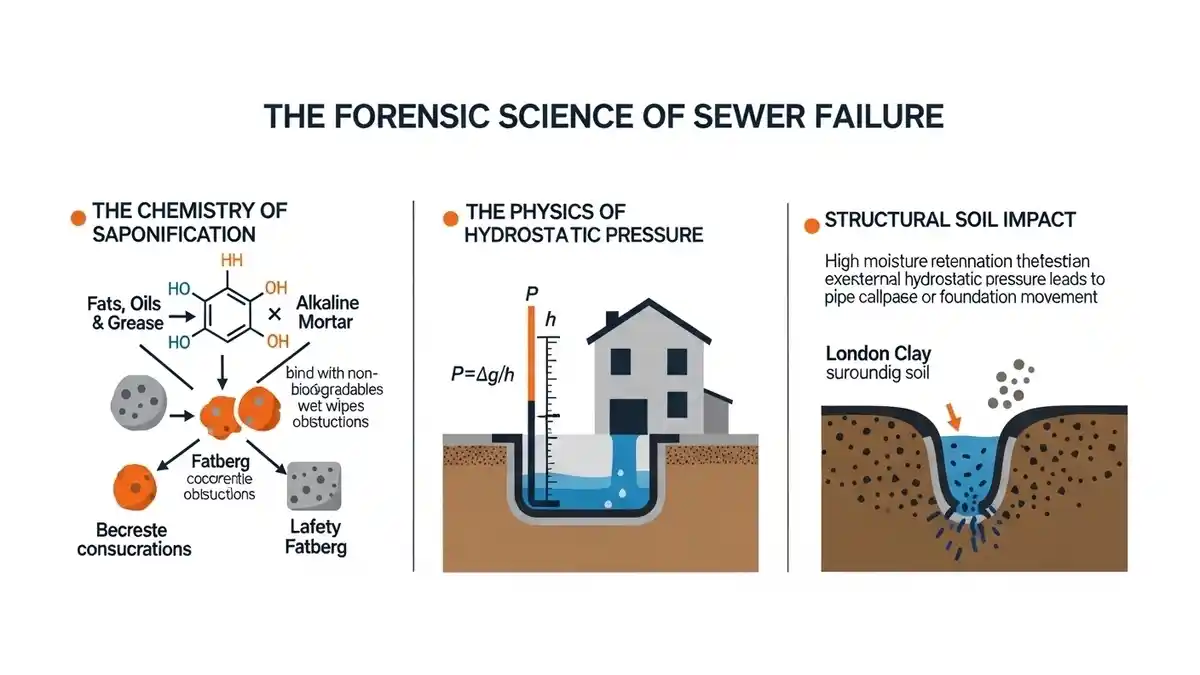
The Mechanism of Saponification and Calcification
The phenomenon commonly referred to as a “fatberg” is not merely a physical accumulation of grease; it is the result of a complex chemical reaction called saponification. This occurs when fats, oils, and grease (FOG)—typically triglycerides—are introduced into the sewer system and encounter alkaline conditions, often provided by the calcium-rich mortar in Victorian brickwork or by chemicals in domestic cleaning agents.
The process involves the breakdown of fats into fatty acids, which then react with calcium and sodium salts found in the wastewater. As these soap-like substances congeal, they act as a “mortar” that binds non-biodegradable items like wet wipes, sanitary towels, and dental floss into a solid, concrete-like mass. Over time, further reactions lead to calcification, in which the mass hardens to the point that standard mechanical rodding becomes ineffective, requiring high-pressure water jetting.
| Component | Origin | Role in Blockage |
|---|---|---|
| Triglycerides | Cooking oils, fats | Primary lipid source |
| Calcium Salts | Alkaline mortar, hard water | Hardening agent |
| Non-biodegradables | Wet wipes, sanitary items | Reinforcement of the mass |
The Physics of Hydrostatic Pressure in Sewer Backups
When a sewer line becomes blocked, the system’s fluid dynamics shift from open-flow to closed-pipe under pressure. For properties in low-lying areas of Bracknell, this pressure can be catastrophic.
Hydrostatic pressure is the weight of a stagnant column of sewage. As the height of the sewage rises in a blocked manhole, the pressure at the bottom increases proportionally. In an emergency scenario, if the main sewer surcharges to ground level, the pressure can exceed the structural capacity of internal pipe seals and joints, leading to a “fountaining” effect through toilets and floor drains in nearby basements.
Lead Engineer Story: The Midnight Call
To illustrate the reality of emergency response, our team reflects on a recent incident managed by our lead engineer during a heavy storm. At 11:47 PM, a priority alert was triggered for a commercial property near the main Road corridor. The building, a mixed-use Victorian structure, was experiencing a total system failure.
Upon arrival, our engineer identified that the external manhole was surcharging, with raw sewage beginning to infiltrate the ground-floor retail space. Using a Ridgid SeeSnake CS12x digital monitor, the team performed an immediate inspection. The footage revealed a massive blockage caused by a combination of a structural collapse and a 125-meter-long fibrous mass of congealed wipes and grease—the “Whitechapel grandchild” of fatbergs in a local context.
The engineer deployed a Whale Tankers KaiserWhale unit to stabilize the situation. The vacuum pump was used to extract the immediate surcharge, while the jetting pump delivered recycled water at high pressure to fragment the calcified blockage. By 3:00 AM, the flow was restored, and the team had transitioned from emergency stabilization to the planning phase for a trenchless CIPP (Cured-In-Place Pipe) repair to address the underlying structural failure. This case highlights that without high-specification equipment and rapid technical decision-making, the property would have suffered irreversible structural damage.
What to do when the sewer backs up at night?
When a property owner discovers a sewer backup during unscheduled hours, the response within the first 60 minutes determines the extent of the eventual damage. Our team recommends a strict three-step protocol:
- Immediate Isolation: Cease all water usage within the property. Every gallon of water sent down the drain (from taps, showers, or washing machines) will exacerbate the backup. If the leak is a clean water burst, turn off the main water supply valve immediately.
- Responsibility Identification: Determine if the issue is private or public. If neighbors are also experiencing slow drains or overflows, or if the flooding is occurring in the street, the responsibility lies with Thames Water. If the problem is isolated to one property, a private 24-hour clogged sewer drain service must be contacted.
- Secure Professional Triage: Contact an emergency sewer line repair service that offers 24-hour coverage. Ensure the provider uses specialized diagnostic cameras to prioritize the call.
How much will this cost me if I wait?
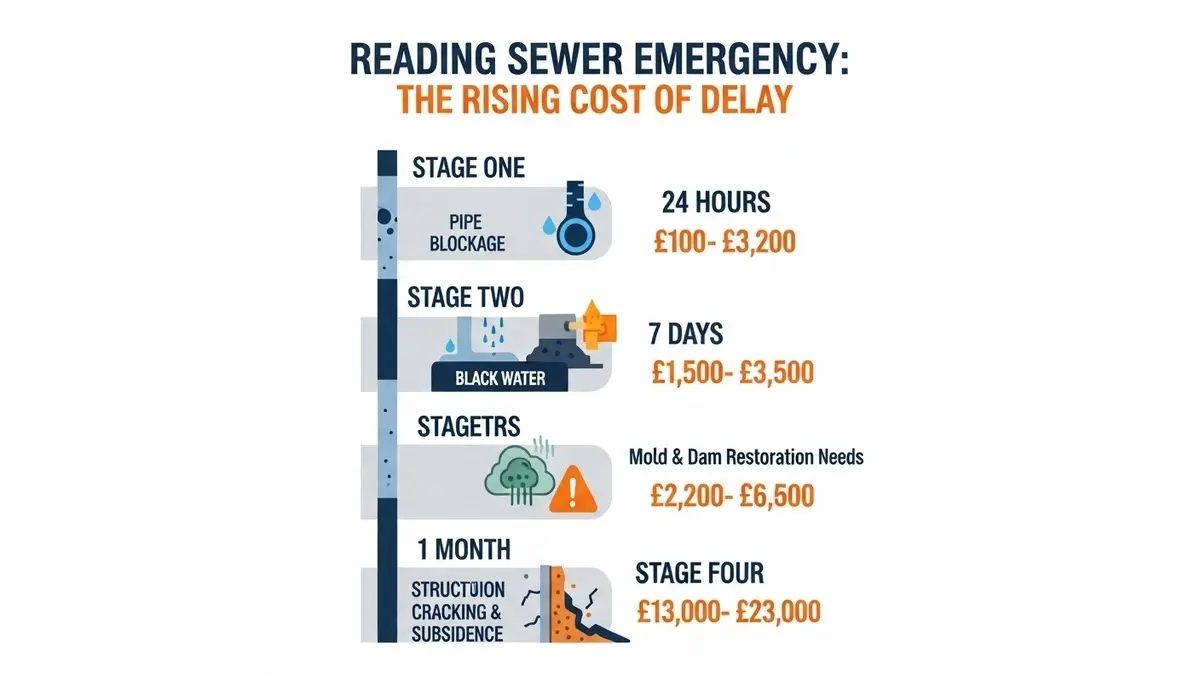
The economic burden of a sewer failure is cumulative. What begins as a minor 24-hour clogged sewer drain service call can escalate into a full-scale structural remediation project if left unaddressed. In Bracknell’s London Clay, a persistent leak from a cracked drainpipe can wash away the supporting soil, leading to foundation movement.
| Delay Duration | Potential Problem | Estimated Cost (Bracknell Region) |
|---|---|---|
| 1-4 Hours | Minor Blockage | £100 - £200 |
| 24 Hours | Sewage Infiltration (Black Water) | £1,500 - £3,500 |
| 7 Days | Mold Growth and Damp Restoration | £2,200 - £6,500 |
| 1 Month | Structural Subsidence | £13,000 - £23,000 |
| Permanent | Property Devaluation | 20% - 25% Reduction |
The Diagnostic Arsenal: Engineering Excellence in the Field
A modern drainage company’s 24/7 emergency service is only as effective as the technology it carries. Our team utilizes a suite of high-performance tools to ensure that “quick response” translates into “first-time fix.”
Ridgid SeeSnake and CSx Monitors
The Ridgid SeeSnake system is the industry standard for sewer line diagnostics. The CS12x monitor allows our engineers to view high-definition images of the pipe interior, identifying signs of an emergency sewer line break that would be invisible to lesser equipment. With Wi-Fi connectivity and the HQx Live app, we can stream the inspection directly to the homeowner’s smartphone, allowing for immediate approval of the repair plan.
Wincan VX and AI Data Management
For larger developments and municipal projects in Bracknell, data must be structured and defensible. Wincan VX software is used to code every defect identified during a survey in accordance with industry standards. This ensures that our recommendations for urgent sewer pipe repair services are based on objective, data-driven analysis rather than guesswork.
Whale Tankers: The Heavy-Duty Solution
When dealing with large-scale blockages on major local roads, our team deploys Whale Tankers.
- Continuous Water Recycling: The Rotomax filter system cleans the wastewater extracted from the sewer, allowing it to be reused for the high-pressure jetting system. This minimizes downtime and the need to tap into clean water supplies.
- High-Volume Vacuum: The liquid ring vacuum pump provides superior lift (down to 8.6m), essential for the deep trunk sewers found in central Bracknell.
- Jetting Performance: With flow rates up to 400 l/min, it can clear blockages that a standard van-pack jetter cannot.
What are the 3 signs a national franchise is overcharging me?
When searching for the best 24-hour sewer repair company reviews, many homeowners are funneled toward large national franchises. While these companies have high visibility, they often employ predatory pricing models.
- The Commission-Based “Upsell” Many national franchises pay their technicians 100% on commission. This means the engineer only makes a profit if they sell you more than just a basic unblock. If a technician arrives for a simple toilet backup and immediately recommends a “whole-house repipe” without providing clear CCTV evidence of a collapse, they are likely following a sales script.
- Ridiculous Diagnostic and Call-Out Fees Legitimate emergency services will charge a call-out fee (typically £80-£150) that covers travel and initial diagnosis. However, beware of companies that charge a high emergency rate plus a separate, hefty “diagnostic fee” just for looking at the drain. A fair emergency fee should reflect the time and urgency, not be a mechanism for “nickel-and-diming” a stressed customer.
- Vague Pricing and “Catch Up” Billing. A trustworthy drainage consultant will provide a transparent pricing breakdown before work begins. Signs of overcharging include technicians who are “boringly vague” about the timeline or who suggest a project takes significantly longer than standard labor estimates. Furthermore, beware of “catch-up” billing, where a low initial bid is steadily increased through “essential extras” once the contract is signed.
Why do franchises charge more when they use local subcontractors?
It is a common industry secret that many national drainage brands do not have their own staff in every region. Instead, they act as expensive middlemen, booking a local independent specialist and adding a 30-50% “management fee” to the invoice. By calling a local specialist directly, you avoid this corporate markup and deal with the person who will actually perform the work. Local businesses rely on word of mouth in the Bracknell community, which means they are more inclined to provide an honest, cost-effective solution than a technician working for a distant head office.
How much will this cost me if I wait for the council to act?
Many residents mistakenly believe that any sewer problem on their street is the responsibility ofthe local council. In reality, the council generally only handles issues related to public highway gullies (road drains). For most sewer line repairs, responsibility is split between the homeowner and Thames Water. Waiting for the council to investigate can waste valuable days, allowing sewage to penetrate your property’s foundation. If the council determines the fault lies on your private line, they can serve a legal notice requiring you to fix it within a set timeframe—often at a much higher cost if they have to arrange the emergency works themselves and recover the fees from you.
CIPP Liner Technology: The Science of Trenchless Repair
For structural failures caused by root intrusion or the shifting of Bracknell’s clay soil, urgent sewer pipe repair services now favor trenchless technology. Cured-In-Place Pipe (CIPP) lining allows our team to rehabilitate a pipe without excavating major roads
Structural Calculations and Material Strength
The design of a CIPP liner must adhere to strict international standards. The liner’s thickness is calculated to ensure it can withstand soil and traffic loads independently of the host pipe. The structural service life is generally rated at 50 years.
| Liner Material | Flexural Strength (psi) | Flexural Modulus (psi) | Tensile Strength (psi) |
|---|---|---|---|
| Standard Polyester Felt | 4,500 | 250,000 | 3,000 |
| Glass Fiber (UV Cured) | 15,000 | 725,000 | 15,000+ |
| Epoxy (Reinforced) | 5,000+ | 5,000+ | 3,000+ |
Flexural strength is the most important factor in determining the thickness of a CIPP liner. Higher strength allows for a thinner design, which reduces material costs and curing time. Tensile strength is vital during installation to prevent excessive stretching or tearing as the tube is inverted or pulled through the Victorian clay conduits.
Prevention and Regulation: The Senior Consultant’s Guide
Prevention is a core pillar of our consulting philosophy. Emergency residential sewer line cleaning is reactive; true infrastructure management is proactive.
- The Three Ps: Never flush anything other than Pee, Poo, and Paper. Even wipes labeled “flushable” do not break down and are the primary cause of fatbergs in Bracknell.
- FOG Management: Pouring fat, oil, and grease down the sink is the fastest way to trigger saponification. Residential and commercial kitchens should use fat traps or “bag and bin” strategies.
- Building Regulations Part H: This document stipulates the requirements for foul water (H1) and building over sewers (H4). For instance, a typical domestic foul drain requires a minimum 100mm diameter pipe with a 1:40 gradient.
- Shared Drain Laws: Under the Water Industry Act 1991, homeowners are responsible for the pipes within their boundary that serve only their property. Any pipe serving more than one property is typically a public sewer maintained by Thames Water.
Sewer gas smell emergency contact.
If you detect a persistent “rotten egg” smell in your home, it indicates a breach in the sewer line or a failure of the ventilation system. This allows methane and hydrogen sulfide to enter the property. In such cases, contact an emergency plumber immediately. If you suspect a gas leak from a utility line, call the National Gas Emergency service and a drainage specialist.
Summary of Emergency Contacts and Costs
When disaster strikes, time is the most expensive variable. Our team provides the following benchmark for Bracknell residents to ensure they are getting a fair and expert service.
| Service Category | Typical Call-Out Fee | Average Hourly Rate | Responsibility |
|---|---|---|---|
| Blocked Internal Toilet | £80 - £150 | £60 - £120 | Homeowner |
| Blocked Shared Drain | £0 (Utility) | £0 | Thames Water |
| Emergency Sewer Cleanup | N/A | £65 - £85 per sqm | Homeowner/Insurer |
| 24/7 Jetting Service | £180 - £300 | £240+ | Homeowner |
Conclusion: Securing Your Property Against Subterranean Failure
The drainage network of Bracknell is a silent, aging giant that requires constant vigilance. From the historic clay pipes of London Road to the modern developments along there, the risks of saponification and structural decay are ever-present. By understanding the science of failure and identifying predatory practices of national franchises, property owners can take control of their infrastructure.
Our team emphasizes that an emergency sewer response is not just about unblocking a pipe; it is about forensic diagnostics using Ridgid and Wincan systems and powerful restoration using Whale Tankers. Whether it is a midnight backup or a structural collapse, the goal is a resilient, long-term fix that protects both the property’s structural integrity and its market value. Proactive management remains the only defense against the inevitable stress of urban drainage.
FAQs
Can I challenge surface water drainage charges?
Does the council repair private sewer lines?
Should I eat food after sewer flooding?
No. You must never consume any food that has come into contact with flood water or raw sewage. Additionally, if your electricity failed during the incident, food in fridges is unsafe after 4 hours to prevent serious infections.
Is there a deadline for fixing leaks?
Yes. Once a leak on your property is confirmed, you are legally responsible for arranging a professional repair within 4 weeks. Failing to act within this window can result in higher water bills and potential enforcement action by utilities.
Can I discharge rainwater into foul sewers?
No. Building regulations mandate separate systems for foul and rainwater. You should connect surface water to combined sewers only if you have exhausted all other methods, such as soakaways or water harvesting, as identified by the national hierarchy.
Talk to your local Bracknell Drainage specialist
We are always happy to arrange a free site assessment and no obligation quotations for any work you might need. Alternatively, you can call our emergency hotline number on